

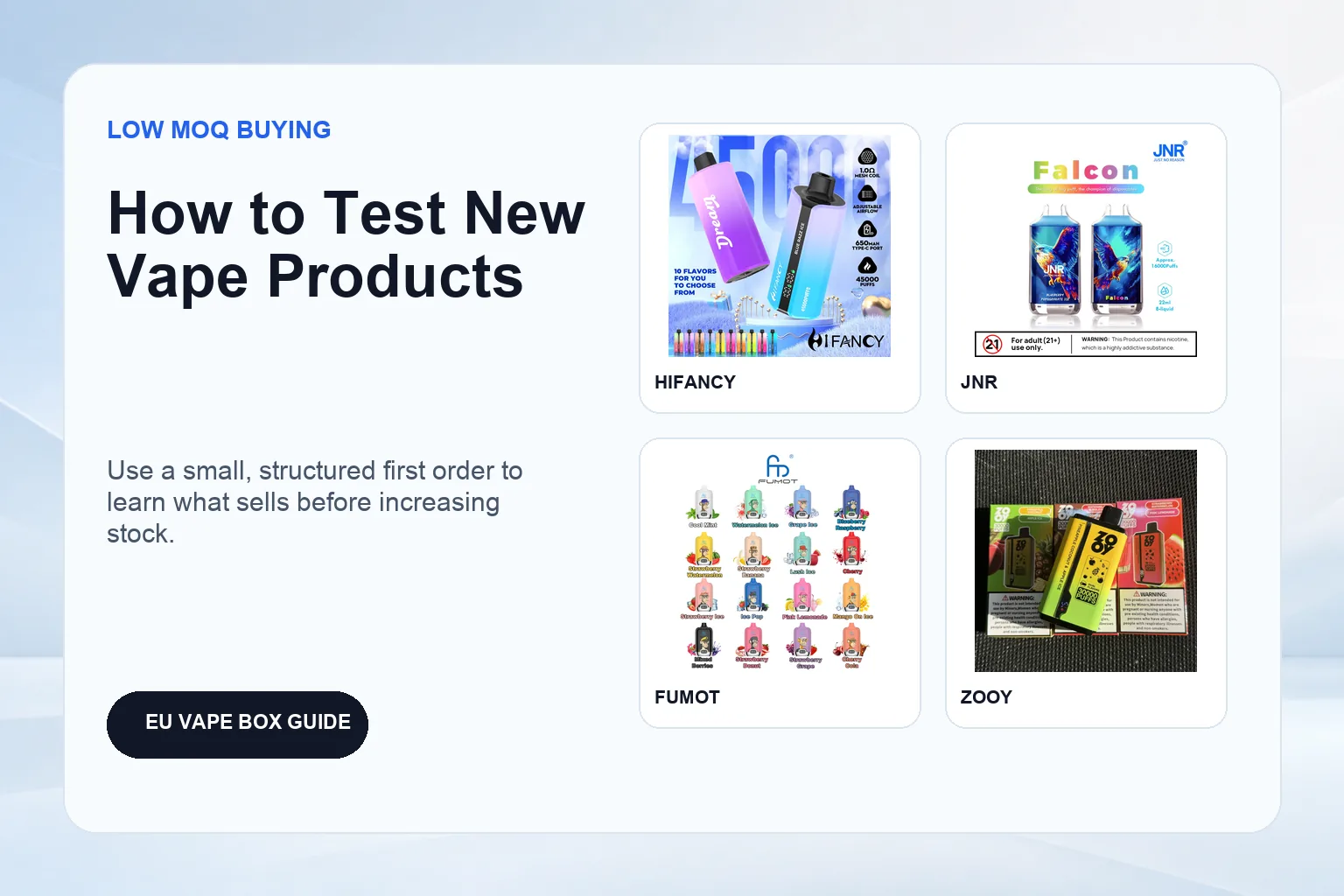
Low MOQ vapes allow a shop or small reseller to test demand without committing to a large first order. The goal is not simply to buy fewer units. A useful test order should answer clear questions about model fit, flavour demand, price acceptance and repeat purchase potential.
Quick answer: Select a narrow customer segment, test a limited number of models and flavours, record every unit in the first order, measure sell-through for a fixed period and reorder only the products that produce reliable demand.
Why Low MOQ Matters
A large assortment can look attractive, but it also spreads cash across more SKUs. Slow-moving flavours may remain in stock while the best sellers run out.
A low minimum order can reduce that risk by letting a buyer:
- compare several product formats;
- test price points;
- learn which flavours move first;
- collect staff and customer feedback;
- preserve budget for replenishment;
- avoid treating catalogue popularity as local demand.
The Low MOQ Vapes category is the starting point for current eligible products. Always read the exact rule on the live listing.
MOQ, Box Quantity and Flavour Mixing Are Different
Three numbers must be separated:
- MOQ: the minimum number of pieces or boxes required;
- box quantity: the number of units packed in one box;
- mix rule: whether flavours or colours can be combined within that minimum.
For example, “MOQ 5 pcs” and “MOQ 1 box” are not equivalent. A five-piece minimum may permit mixed flavours, while a box may use a fixed assortment. Do not infer one rule from another product in the same brand.
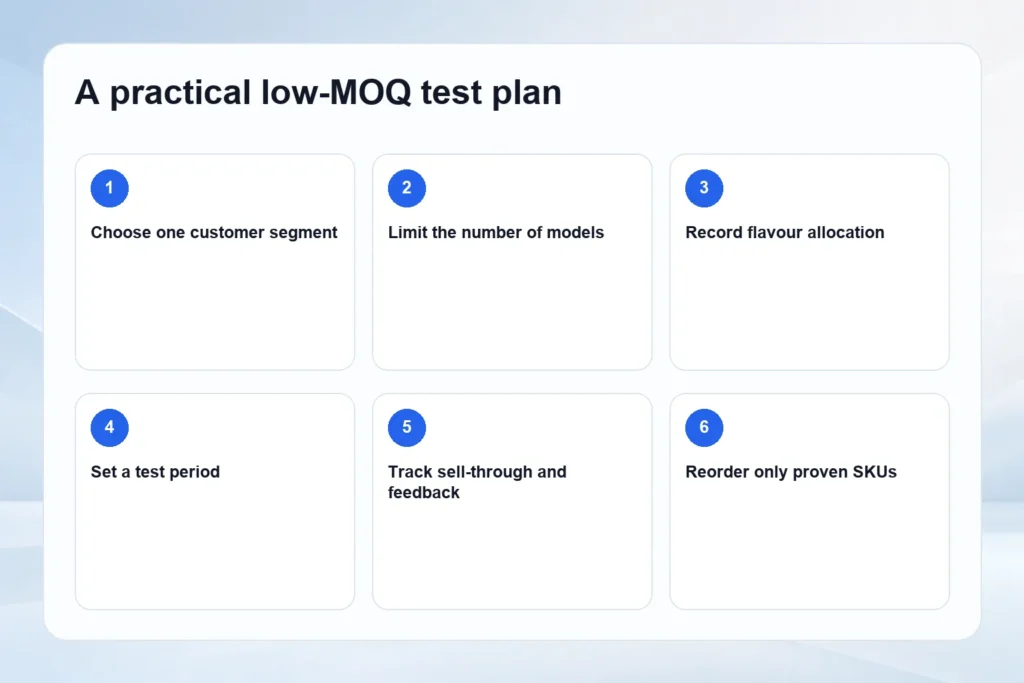
A Six-Step Test Plan
1. Define the buyer you are testing for
Choose one primary segment: adult personal buyers, existing disposable users, multi-flavour customers, pod-system users or shop customers seeking a particular price range.
If the audience is too broad, the result will not explain why a product succeeded or failed.
2. Limit the model count
Start with a small number of clearly different models. Testing six nearly identical products makes the data harder to read. A better first test might compare:
- one familiar single-format disposable;
- one multi-flavour device;
- one compact model;
- one larger flagship format.
3. Plan the flavour allocation
Use a balanced flavour structure rather than selecting only personal favourites. Depending on the available list, include a mix of fruit, ice, mint, beverage or familiar high-demand profiles.
Record the exact flavour and quantity for every unit. “One mixed box” is not enough information for the later review.
4. Set a test period
Choose a fixed period long enough to observe demand but short enough to support a timely reorder. Avoid comparing one product with seven days of exposure and another with a month.
5. Measure useful outcomes
Track more than sales count:
- units received;
- units sold;
- days to first sale;
- flavour sell-through;
- repeat requests;
- returns or complaints;
- staff questions;
- requests for unavailable variants.
6. Reorder the winners
Increase stock only when the result is clear. A model that sold once at launch is not necessarily proven. Look for consistent sell-through and a practical margin after delivery and operating costs.
Build a Simple Test Matrix
| Field | What to record |
|---|---|
| Brand and model | Exact product name |
| Format | Disposable, pod system, e-liquid or pouch |
| Flavour | Exact variant or assortment |
| Purchase quantity | Pieces and boxes |
| Landed cost | Product plus relevant delivery cost |
| Selling price | Actual test price |
| Units sold | Count during the fixed period |
| Feedback | Repeated positive or negative comments |
| Decision | Stop, retest or reorder |
This turns a small order into a repeatable buying process.
How Many Flavours Should You Test?
There is no universal number. It depends on the MOQ, box structure and customer volume. The principle is to test enough variety to identify patterns without giving each flavour too little exposure.
If the MOQ allows five mixed pieces, five carefully selected flavours may be a sensible first signal. If the product is sold only by a fixed box, record the assortment and judge both the model and the distribution of flavours inside that box.
Use Real Product Families, Not Generic Labels
Compare exact models because range structure differs by brand. Current brand pages include HIFANCY, JNR, FUMOT and ZOOY.
The live product or brand page should confirm whether the current offer is piece-based, box-based or available only in particular warehouses. Model availability can change, so keep the test sheet dated.
Avoid These Low-MOQ Mistakes
- ordering too many models at once;
- treating mixed flavours as random flavours;
- failing to record the first assortment;
- comparing sales without using the same test period;
- buying only the largest puff figure;
- ignoring device complexity and customer explanation;
- assuming one model’s MOQ applies to the entire brand;
- reordering before checking returns and complaints;
- holding too little of a winner to complete the test.
Personal Buyers and Trade Buyers
An adult personal buyer may use a low MOQ to avoid a large commitment to one flavour. A trade buyer needs a more structured test because the objective is repeatable stock planning.
For shops, add two questions:
- Can staff explain the product clearly?
- Can the same winning SKU be replenished from a suitable EU warehouse?
A good test result is less useful if the item cannot be reordered reliably.
Frequently Asked Questions
Does low MOQ always mean single-unit ordering?
No. It may mean a small piece minimum or one box. Check the exact listing.
Can every low-MOQ order mix flavours?
No. Some models permit mixed flavours, while others use fixed box assortments.
Should I test several brands at once?
You can, but keep the models different enough that the result is understandable and the total SKU count manageable.
What is the best metric?
Sell-through during a fixed period is useful, but combine it with repeat requests, margin, feedback and availability.
Where can I find current options?
Browse Low MOQ Vapes and the main Shop, then confirm the live MOQ and flavour rule.
Start Small, Learn Clearly
A low MOQ is most valuable when the order is designed as a test. Limit variables, document the assortment and decide in advance what result will justify a reorder.
Browse current low-MOQ products and use the live listing as the final reference for stock, packing and flavour selection.