

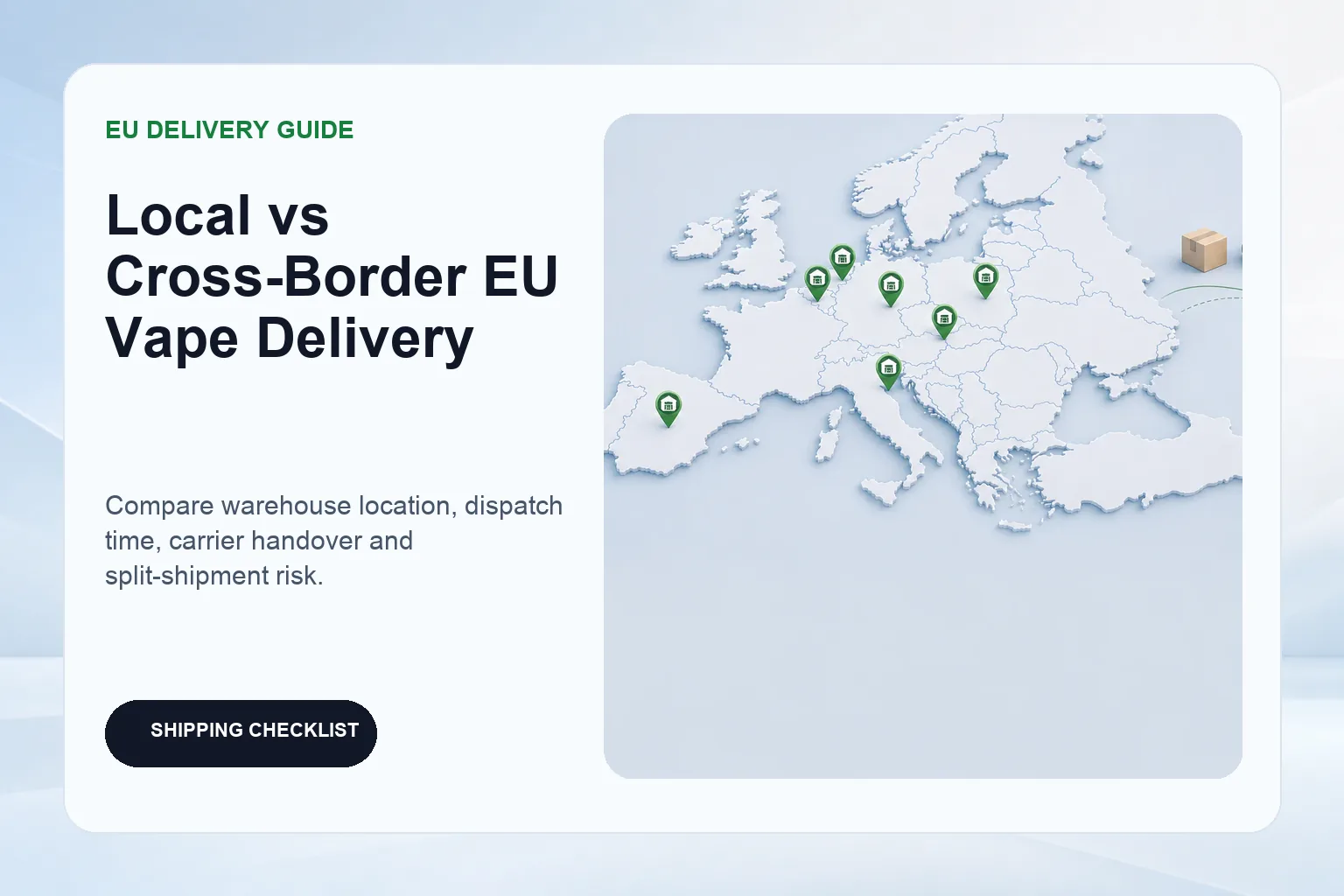
EU vape delivery is not determined by distance alone. The warehouse that actually holds the stock, the dispatch cut-off, the carrier service, weekends, destination restrictions and whether an order must be split all influence the final timeline.
Quick answer: A parcel sent from a warehouse in the buyer’s country will often have fewer transport stages than a cross-border EU parcel, but it is not automatically faster. Confirm live stock, dispatch country, carrier and tracking for the exact order before relying on an estimate.
This guide explains the practical difference between local and cross-border fulfilment for adult buyers, vape shops and small resellers ordering from EU warehouse stock.
What Counts as Local EU Delivery?
Local delivery means the parcel is dispatched from a warehouse in the same country as the delivery address. For example, stock held in Poland and sent to a Polish address would be a local shipment.
Potential advantages include:
- fewer border-to-border transport stages;
- familiar domestic carrier networks;
- easier interpretation of local tracking events;
- a lower chance of an international line-haul delay.
However, local stock still needs to be picked, packed and handed to the carrier. An order placed after the warehouse cut-off or during a weekend can leave later than an earlier cross-border order.
What Counts as Cross-Border EU Delivery?
Cross-border delivery means the dispatch warehouse and destination address are in different EU countries. The parcel may travel through one or more sorting hubs before reaching the destination carrier network.
This does not necessarily mean a long delay. Many European parcel services operate regular cross-border routes. The practical difference is that there are usually more stages where timing can vary:
- warehouse processing;
- collection by the origin carrier;
- line-haul transport between countries;
- transfer to the destination network;
- local delivery.
The carrier, service level and route matter more than a simple kilometre estimate.
A Realistic Delivery Timeline Has Two Parts
Buyers often use “delivery time” to describe the full period from checkout to arrival, but that period contains two separate stages.
Dispatch time
Dispatch time covers stock allocation, order checks, packing, label creation and carrier collection. A tracking number may be created before the parcel receives its first physical scan.
Carrier transit time
Transit starts after the carrier accepts the parcel. Tracking may show collection, depot processing, line haul, destination sorting and out-for-delivery events.
When comparing options, ask for both the expected dispatch window and the carrier transit estimate. Adding only the carrier estimate can create an unrealistic expectation.
Local vs Cross-Border: What Usually Changes?
| Factor | Local delivery | Cross-border EU delivery |
|---|---|---|
| Transport stages | Usually fewer | Usually more |
| Carrier network | Primarily domestic | Origin, line haul and destination stages |
| Tracking language | Often local | May change between networks |
| Weekend effect | Depends on domestic schedule | Can affect more than one network |
| Split-shipment risk | Low if all stock is local | Higher when items are stored in different countries |
| Best check | Warehouse cut-off and local service | Route, handover and destination service |
This table is a planning guide, not a guarantee. Actual service depends on the exact parcel and destination.
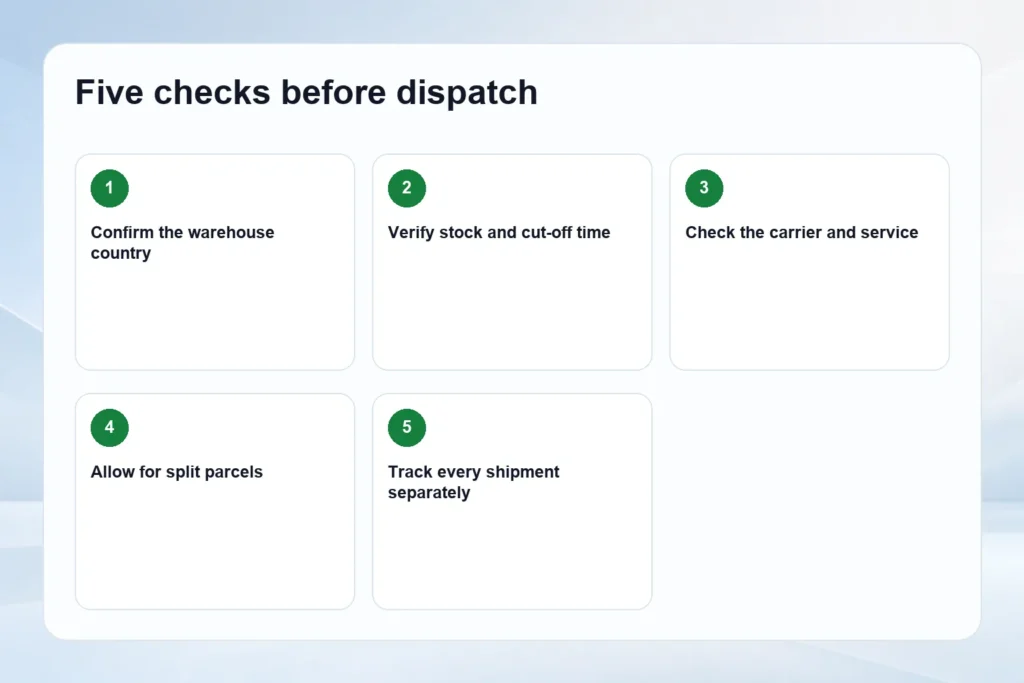
Five Checks Before Dispatch
1. Confirm the dispatch warehouse
Do not assume the nearest warehouse holds every selected model and flavour. Check the current warehouse shown for each product or review the EU warehouse vape category.
2. Verify live stock
A listing can contain several flavour variants, while only part of the assortment is available in one warehouse. Confirm that the chosen items can be allocated together.
3. Check the cut-off and operating days
An order placed late on Friday may not move like an order placed early on Tuesday. Public holidays can also affect the warehouse, origin country or destination country.
4. Identify the carrier and service
Tracking behaviour differs between DPD, DHL, UPS, GLS, FedEx, BRT, CTT Express and SEUR. Use the carrier named in the shipment notification and enter the number on that carrier’s official tracking page.
5. Ask whether the order will be split
If one order uses two warehouses, it may arrive as separate parcels. Each parcel needs its own tracking number and can arrive on a different day.
Why a Tracking Number May Not Update Immediately
A label can be created before collection. During that interval, the number exists but the carrier may display only “information received” or no movement.
Allow time for the first physical scan. If there is still no update after the expected handover window, contact support with:
- buyer name;
- order number;
- tracking number;
- destination postcode;
- the carrier shown in the dispatch message.
These details make it easier to distinguish a label delay from a route or address issue.
Common Causes of Delay
Even an EU warehouse order can be delayed by:
- a selected flavour becoming unavailable before allocation;
- an incomplete or incorrect address;
- a carrier collection missed after the daily cut-off;
- weekends or public holidays;
- parcel-volume peaks;
- weather or transport disruption;
- a failed delivery attempt;
- destination rules affecting the shipment;
- a split order where one parcel moves later.
The Shipping & Delivery page should be the reference for the store’s current shipping process. Product availability should be checked again when the order is placed.
How Shops Can Plan Restocking
Retailers should not use the fastest previous parcel as the permanent planning time. A safer method is to record several deliveries by route and calculate a working range.
Track:
- order date and time;
- warehouse country;
- dispatch date;
- first carrier scan;
- arrival date;
- exceptions or failed attempts.
After several orders, the shop will have a more useful route history than a single advertised estimate. Reorder before critical stock reaches zero, especially for cross-border lines or fast-selling flavours.
Frequently Asked Questions
Is delivery from an EU warehouse always domestic?
No. EU warehouse stock may be sent locally or across an EU border, depending on the stock location and destination.
Is local delivery always faster?
Not always. Warehouse processing, cut-off time and carrier schedules can outweigh distance.
Can one order have several tracking numbers?
Yes. If products are dispatched from different warehouses or parcels, each shipment can have its own number.
When should I start checking tracking?
Use the tracking number after the dispatch notification. A short delay before the first carrier scan can be normal.
Where can I find current warehouse products?
Browse EU warehouse vape stock and open the current product listing before ordering.
Plan with the Actual Route
The most reliable EU vape delivery estimate begins with the exact stock location and destination—not a general promise. Confirm the warehouse, dispatch window, carrier, split-shipment status and tracking number for the order.
Review current EU warehouse stock or read the store’s Shipping & Delivery information before planning the next order.